
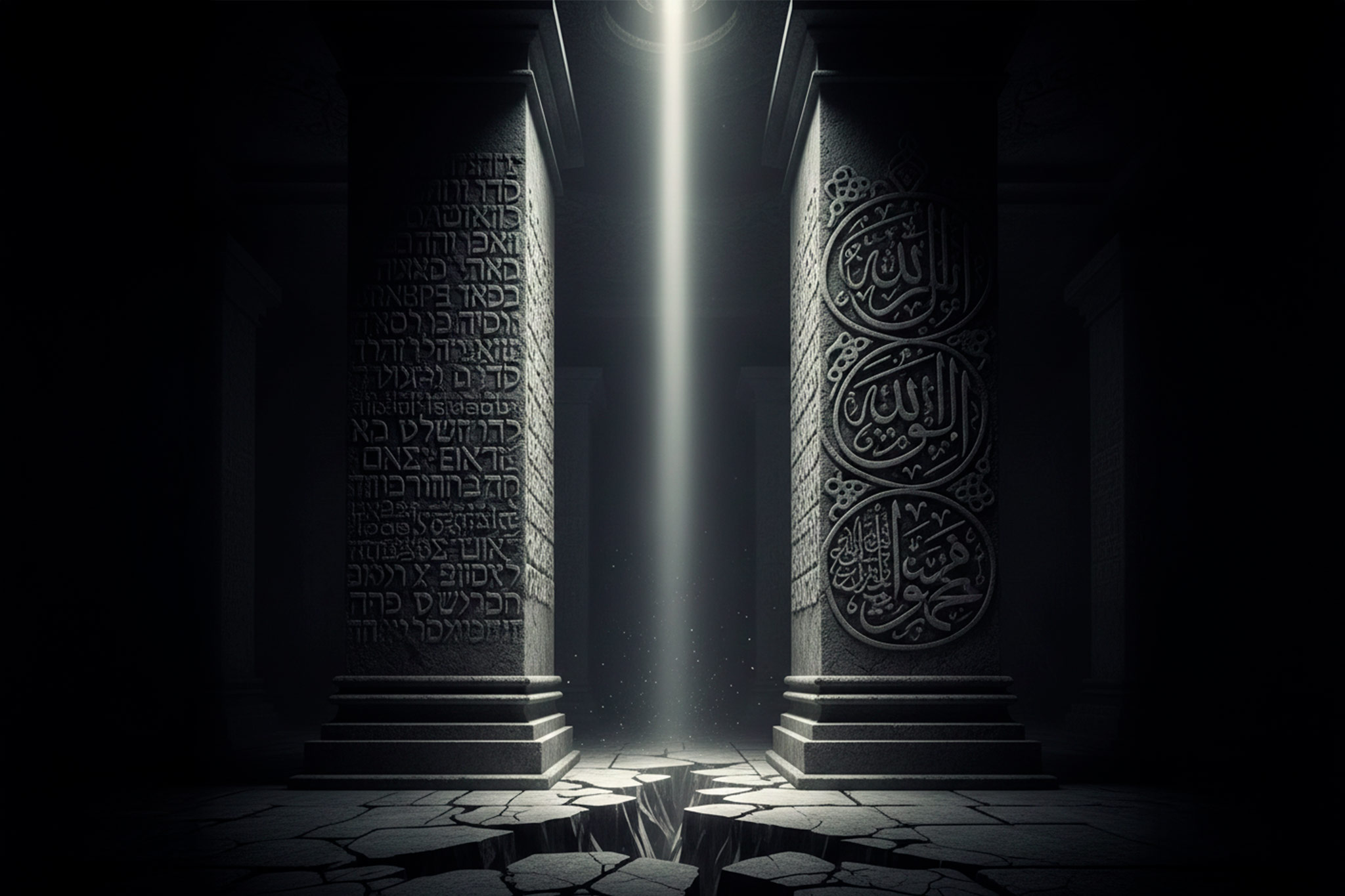
Imagine converting to a new faith, only to encounter a foundational challenge (The Islamic Dilemma) you’ve never considered. That was the reality for “Elijah,” a new Muslim since November of last year, when he entered a live discussion and came face-to-face with a powerful logical problem.
This problem, known as “the Islamic dilemma,” places the Quran in a logical “double bind” regarding the scriptures that came before it—namely, the Bible. The conversation that unfolded revealed a profound challenge not just to Islam’s holy book, but to the very consistency of its prophetic claims. This article will explore the most impactful takeaways from that exchange and the unavoidable questions they raise.
The Quran Puts Itself in a Logical “Double Bind”, The Islamic Dilemma

The speaker began by laying out a logical catch-22 at the heart of Islam. The Quran repeatedly affirms the divine origin and truthfulness of the previous scriptures, the Torah and the Gospel (the Bible). However, it also presents a message that fundamentally contradicts the core theology of those same scriptures, especially regarding the identity and mission of Jesus Christ.
This creates an inescapable dilemma:
• If the previous scriptures (the Bible) are true, then the Quran must be false because it contradicts them on essential points like the crucifixion of the Messiah.
• If the previous scriptures are false (corrupted), then the Quran must also be false because it repeatedly and explicitly states that they are true and are revelation from Allah.
The Quran’s own standard of truth becomes the instrument of its own undoing. To make this clear, the speaker used a simple analogy: if you vouch for your friend’s version of a story, declaring it to be true, but then immediately tell a contradictory version of that same story, your own testimony is invalidated. “That would mean that what I’m saying is false,” he concluded.
As the speaker summarized the Islamic Dilemma for Elijah:
This is what we call the Islamic dilemma because it puts the Quran in a double bind. Whichever way you go, it doesn’t matter. The Quran is false. Because if the previous scriptures are true, then the Quran is false because it contradicts them. If the previous scriptures are false, then the Quran is false because it says these scriptures are true.
The Quran Itself Seems to Forbid Believing in Just “Parts” of Scripture
Anticipating the common objection that the Bible is only partially true, the speaker demonstrated how the Quran itself closes this escape route. He argued that the idea of “cherry-picking” the Bible is a direct violation of the Quran’s own commands.
First, he guided Elijah to Quran, Chapter 5, verse 68, where Allah tells the “people of the book” (Jews and Christians) they have “nothing to stand on unless you observe the Torah and the Gospel.” The command is to observe their scriptures in their entirety, not just select portions.
Next, the speaker strategically turned to Quran, Chapter 2, verse 85 to show that the Quran explicitly condemns the very practice of partial belief.
Do you believe in some of the scripture and reject the rest? Is there any reward for those who do so among you other than disgrace in this worldly life and being subjected to harshest punishment on the day of judgment…
This created a direct internal contradiction for the “partial corruption” theory. According to its own text, the Quran commands followers to observe the entire Torah and Gospel and warns of severe punishment for those who attempt to pick and choose which parts to believe.
Ancient Jewish Prophets Described Jesus’s Crucifixion in Startling Detail

With the logical framework established, the speaker then walked Elijah, step-by-step, through the ancient scriptures. He demonstrated a consistent prophetic thread that Islam’s denial of the crucifixion—the central contradiction between the two faiths—directly severs.
• Genesis (Moses): The argument began in the Torah with Genesis 3:15, a prophecy about a “seed of the woman” who will be “bruised.” The speaker connected this unique phrasing to a virgin-born Messiah whose suffering was integral to his mission.
• Psalms (David): Written 1,000 years before Jesus, Psalm 22 describes a crucifixion with shocking precision. David writes of someone whose hands and feet are pierced (“they pierced my hands and my feet”), who is mocked by onlookers (“He trusts in the Lord… let him deliver him”), and whose clothes are gambled for (“They part my garments among them and cast lots upon my vesture”). When the speaker asked Elijah what this scene sounded like, his response was immediate and unfiltered: “Jesus. Jesus Christ. And what specific event? The crucifixion.”
• Isaiah: Next, they turned to Isaiah 53, written 700 years before Jesus. The prophet describes a suffering servant who was “wounded for our transgressions,” took the “punishment that brought us peace,” and by whose “stripes we are healed.” The speaker asked who this sounded like. Elijah’s concession was just as clear: “That does sound like Jesus.” The speaker’s reply captured the weight of the moment: “Boom. Boom.”
• Zechariah: Perhaps the most stunning prophecy came from Zechariah 12:10, where God himself is speaking: “they shall look upon me whom they have pierced.” The speaker drove home the theological impossibility of this statement—”How’s that even possible?”—unless, he concluded, “God comes in the flesh” to be pierced by his own people.
Jesus Claimed These Ancient Scriptures Were All Pointing to Him
The final piece of evidence came from Jesus himself. The speaker showed how, after his resurrection, Jesus appeared to his disciples and claimed this entire, consistent prophetic tradition for himself. Referencing the account in Luke 24:44-47, the speaker highlighted Jesus’s own words, which tie all the ancient prophecies together.
“These are the words which I spoke to you… that all things must be fulfilled which were written in the Law of Moses, and in the Prophets, and in the Psalms concerning me… Thus it is written… that the Christ should suffer, and rise from the dead the third day.”
With this statement, Jesus claims that the singular, consistent message of the Jewish scriptures—from Moses to David to the prophets—was that the Messiah must suffer and die.
The Unavoidable Choice due to the Islamic Dilemma

The argument presents a stark and unavoidable contrast. On one side stands a consistent line of prophecy stretching over a thousand years—from Moses, David, Isaiah, and Zechariah, all confirmed by Jesus Christ himself—testifying that the Messiah would suffer and be crucified for the sins of the people. On the other side, Muhammad arrives centuries later with a message that directly contradicts this entire narrative.
The Quran’s command to believe the previous scriptures is what gives this mountain of prophetic evidence its devastating force within an Islamic framework. Muhammad’s claim to be a prophet fails the test of consistency with the very revelations his own book affirms. This is made even more acute by the fact that these Old Testament prophecies are found in the Dead Sea Scrolls, texts that predate Jesus by hundreds of years, making the common claim of “corruption” historically untenable.
This Islamic Dilemma forces a decision, encapsulated in the final, thought-provoking question the speaker posed to Elijah, leaving him to ponder the choice before him:
“Who do you go with: the line of prophets who are consistent with each other, or the one who contradicts these prophets while at the same time claiming to be in line with them?“
Source: GodLogic2.0: New Muslim Hears the Islamic Dilemma for the First Time
More Apologetic Blogs >>