
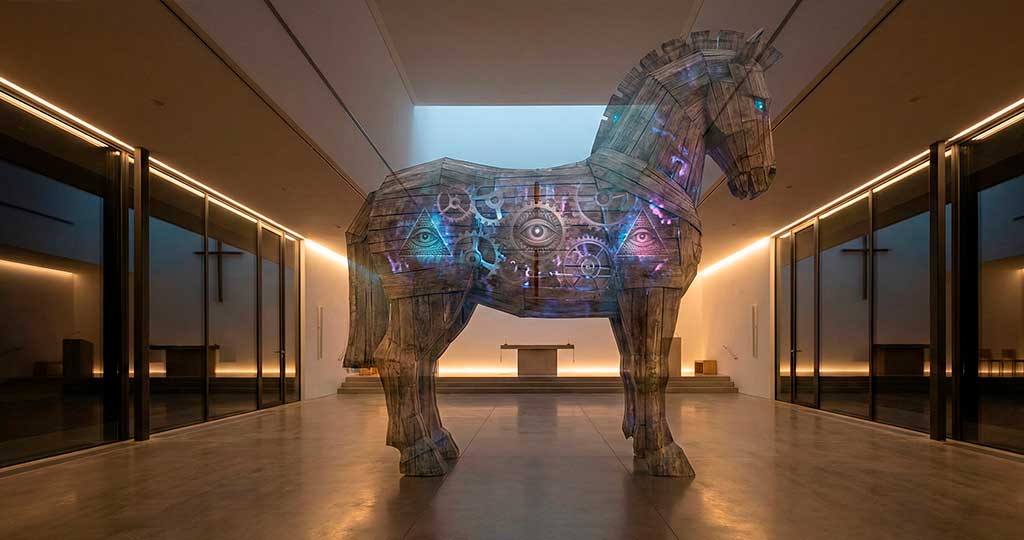
1. Introduction: The Spiritual Trojan Horse
Many modern seekers hold beliefs they consider “progressive” or “spiritual,” unaware that they are participating in a New Thought movement with deep historical and metaphysical roots. This influence operates through “Happy Lies”—ideological Trojan horses that appear attractive and empowering on the outside but harbor a syncretic deception within. These beliefs promise personal authority and manifestation, yet they are often a subtle rebranding of ancient ideas that function as something entirely different from traditional faith. By analyzing the mechanics of this hidden influence, we can see how it has shaped a world that is increasingly self-obsessed while remaining ontologically adrift.
2. New Thought Movement vs. New Age: Why the “Christian” Version is More Dangerous

There is a critical distinction between the “New Age” movement and the New Thought movement. New Age is generally recognizable as occultic, rooted in Eastern mysticism, Hinduism, and Buddhism. It is the “red dude with the pitchfork”—obvious in its use of tarot cards, chakras, and reiki.
New Thought, however, is far more deceptive because it presents itself as “metaphysical Christianity.” It utilizes familiar biblical vocabulary but subjects it to a radical hermeneutical reinterpretation. In this worldview, Jesus is a “way-shower” or a “mascot” rather than a singular Savior. Because it wears the mask of the church, it is more influential and harder to detect.
“Wow, you will be as God. Sounds like a slimy serpent to me.”
This realization—that the promise of personal divinity is the original deception of the Garden—serves as the turning point for those who recognize they have fallen for a Christianized version of the occult.
3. The Great Equivocation: When “Christ” and “Jesus” Part Ways
A cornerstone of the New Thought movement is the concept of “Christ Consciousness,” which stems from Gnostic origins. Gnosticism splits reality into the material (viewed as lesser or evil) and the spiritual (viewed as good). To make this fit a Christian framework, the movement separates the person of Jesus from the office or title of “Christ.”
The movement relies on gnosis—secret or esoteric knowledge. This “hidden” meaning is often supported by forged Gnostic gospels, such as the Gospel of Thomas or the Gospel of Mary. By redefining “Christ” as a level of consciousness that Jesus obtained—and that any person can also obtain—followers claim they are “every bit as much of Christ as Jesus was.” This ignores the actual standard of divine holiness, creating a massive gap between human effort and reality.
“God’s standard… let’s pretend it’s like Jupiter, the outer rings of it… Now try to jump and touch the [six-foot] ceiling. Compared to Jupiter… you’re a terribly lousy jumper.”
4. The Burden of Self-Divinity in the New Thought Movement

The New Thought movement is built on “idealism”—the belief that the material world is merely a response to the mind. This is the foundation of the modern self-help movement, with roots stretching back to the 1600s and 1800s. Foundational authors like Wallace Wattles, Neville Goddard, and Emma Curtis Hopkins (who pioneered the “God is good” affirmation) taught that we create our own reality through correct thinking.
While this sounds empowering, it is a form of “soft legalism.” If you are the creator of your world, you are also your own savior, placing an unsustainable burden on the individual. Furthermore, this “mental mastery” often overlaps with unintended occultic experiences; the source mentions “visitors” (demonic entities) and the “astral plane” as the dark side of seeking higher spiritual frequencies.
Specific beliefs in this category include:
- Wealth Frequencies: The idea that positive emotions attract financial prosperity.
- Affirmative Prayer: Demanding or declaring a reality rather than submitting to God’s will.
- I AM Affirmations: Using the divine name to claim personal power over circumstances.
- Quantum Pseudoscience: Misusing physics concepts like “vibration” to justify mind-over-matter.
5. Exploiting the Wound: How Pain and Distrust Fuel Deconstruction
The transition into the New Thought movement often follows a psychological path through three “boxes”:
- Box 1: Traditional or Evangelical Christianity.
- Box 2: Deconstruction, fueled by valid pain or distrust of institutions like the church, media, or government.
- Box 3: New Thought or Progressive Christianity.
Leaders like Richard Rohr—often called “The Pope of Progressive Christianity”—gain trust by rightly criticizing the flaws of Box 1. Once trust is established, they “smuggle in” a different worldview. This is a psychological bait-and-switch. The seeker lands in a “drone of uncertainty,” constantly deconstructing their “false self” (social constructs) to find a divine “true self.” Because they are afraid of rebuilding a false identity, they can never commit to objective, ontological truth.
6. The “Endless Mirror” and the Abyss of Self-Obsession

The New Thought movement frequently employs the imagery of the mirror, teaching that when you look in the mirror, “there’s a God looking back at you.” This creates an “endless mirror” of self-focus, where the individual becomes the ultimate source of truth, authority, and salvation.
This self-obsession contrasts sharply with the Christian view, where the “True Self” is not found by looking inward, but is “hidden in Christ.” The Greeks warned that looking into mirrors to one’s own peril leads to a fall; similarly, New Thought leads followers into an abyss of darkness while they believe they are moving toward light. It is pride disguised in the language of humility.
7. Conclusion: The Sustainable Truth
Ultimately, “Happy Lies” offer a temporary rush of power and control, but they are unsustainable. Like the “physical bread” mentioned in the paraphrase of John 6, these beliefs leave the seeker hungry again. They offer a “Kingdom without the King”—all the promises of spiritual abundance without the necessity of a relationship with the actual Creator.
The alternative is to lay down the burden of self-divinity and submit to reality as it is revealed. True freedom is found not in manifesting a personal reality, but in submitting to the one who is the “Bread of Life.” Real peace begins when you stop trying to climb the “God ladder” and acknowledge the limits of your own power. Are you seeking the benefits of the Kingdom while trying to avoid the King?
SOPURCE: The Dangerous Rise Of Fake Christianity (Full Podcast!), Daily Dose Of Wisdom
Happy Lies Book: https://amzn.to/3NOR0PH
Bible Verse References & Hints
Genesis 3:5 (ESV) “For God knows that when you eat of it your eyes will be opened, and you will be like God, knowing good and evil.” Hint: Cited in the blog as the “original deception”—the promise that you can be your own god, which mirrors the core teaching of New Thought.
Colossians 2:8 (ESV) “See to it that no one takes you captive by philosophy and empty deceit, according to human tradition, according to the elemental spirits of the world, and not according to Christ.” Hint: Warns against “philosophy and empty deceit,” fitting the description of “Happy Lies” and the syncretic nature of New Thought vs. biblical truth.
John 6:35 (ESV) “Jesus said to them, ‘I am the bread of life; whoever comes to me shall not hunger, and whoever believes in me shall never thirst.'” Hint: Contrasts with the “physical bread” mentioned in the conclusion; New Thought leaves you hungry, but Jesus is the sustainable Bread of Life.
Colossians 3:3 (ESV) “For you have died, and your life is hidden with Christ in God.” Hint: Supports the section on the “True Self”—our identity is found “hidden in Christ,” not by looking in a mirror at ourselves.
Matthew 24:24 (ESV) “For false christs and false prophets will arise and perform great signs and wonders, so as to lead astray, if possible, even the elect.” Hint: Supports the warning about deception that wears the “mask of the church” (metaphysical Christianity) and is harder to detect, potentially fooling even believers.
Romans 1:25 (ESV) “because they exchanged the truth about God for a lie and worshiped and served the creature rather than the Creator…” Hint: Describes the core error of the “Endless Mirror”—worshipping the self (creature) as divine instead of submitting to the Creator.

