
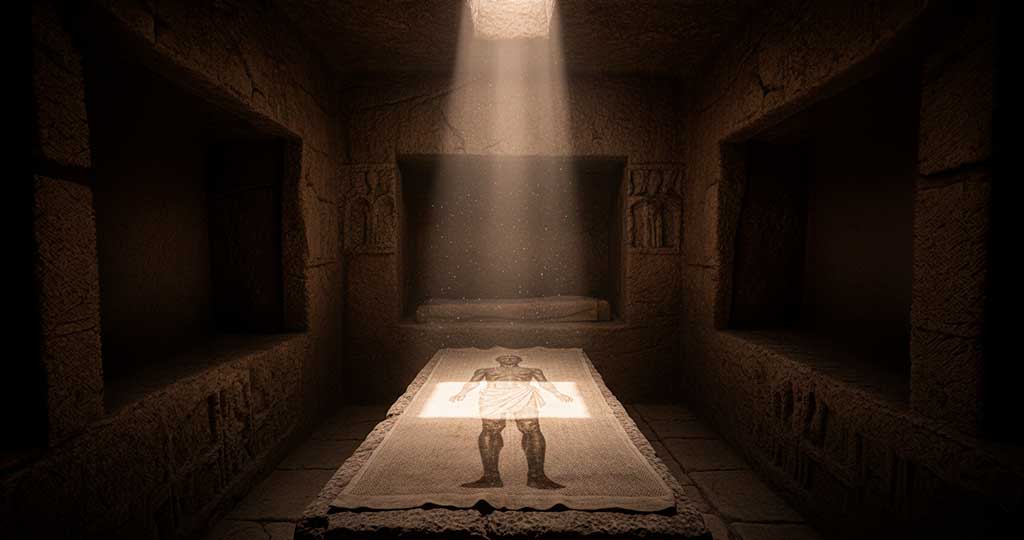
1. Introduction: The Relic That Refuses to Be Debunked
If you visit The Kilns, the Oxford home of C.S. Lewis, you might notice an anomalous artifact above the mantle in the bedroom where he died. It is a 1931 photograph of the Shroud of Turin. Lewis, an intellectual giant and an Anglican, kept it there as a daily reminder that “our God has a face.” For a generation, the cloth was relegated to the attic of medieval curiosities, seemingly “debunked” by a 1988 radiocarbon study. However, the tide has turned; being “rational” in the 21st century actually points toward the cloth’s authenticity. It remains the only archaeological artifact that captures the forensic intersection of death, burial, and resurrection in a single piece of linen.
2. The Vanishing Image: A Mystery of Superficiality
One of the most baffling physical properties of the cloth is the “8-foot rule.” If a researcher stands closer than eight feet, the image of the man effectively vanishes. This creates a logical loop for the “forgery” theory: a medieval artist would have had to paint a 3D topography he could not see while standing close enough to apply the pigment. The image is not composed of paint, dye, or binders; it is a phenomenon of extreme superficiality. According to the Shroud of Turin Research Project (STURP), there is no evidence of a human hand at work. “We have proven… according to science it is not man-made.”
3. The 34-Trillion-Watt “Selfie”: The Moment of Resurrection

Modern analysis suggests the image was formed by a massive burst of vacuum ultraviolet radiation, a “natural effect of a supernatural cause.” To achieve this level of detail on the fibers, it would require 34,000 trillion watts of energy delivered in just 1/4th of a billionth of a second. This burst acted as a “photographic negative,” scorching the fibers to encode high-resolution 3D information. This is described as the “first selfie,” a physical snapshot captured at the exact instant of resurrection. This theory explains how the cloth contains a “blueprint” of a body that transitioned from material to glorified light.
4. The Carbon-14 “Hoax”: Why the 1988 Study Failed
The 1988 study is often cited by skeptics as definitive proof of a hoax, but the announcement itself was rife with bias. We now know the British Museum suppressed the raw data for 29 years, and the fragment tested was taken from a contaminated corner patched after the fire of 1532. When we move past this flawed study, the Shroud of Turin tells a different story. Using Wide-Angle X-ray Scattering (WAXS), scientists measured the degradation of the linen fibers and found a direct correspondence with the AD 70 Masada shroud, placing the cloth firmly in the time of Jesus.
5. The Silent Correspondence: Forensic Evidence

The linen does not exist in a forensic vacuum; it has a “silent witness” in the Sudarium of Oviedo, the headcloth mentioned in the Gospel of John. While the Shroud of Turin history is centered in the East, the Sudarium has been documented in Spain since the 7th century. The matches are staggering:
- Geometry: A one-to-one correspondence in blood stains and facial geometry.
- Blood Chemistry: Both cloths feature type AB blood—a rarity globally.
- Clinical Signature: Both show a 6-to-1 ratio of pulmonary edema fluid to blood, the medical signature of death by asphyxiation.
6. The “Helmet” of Thorns: Biblical Accuracy

Traditional art depicts the “Crown of Thorns” as a simple wreath, but the cloth offers a more brutal reality. The man was subjected to a “Helmet of Thorns”—a cap that covered the entire scalp. This matches the Roman soldiers’ intent to mock a king with a caricature of a royal miter. The Shroud of Turin reveals approximately 50 puncture wounds in the scalp. A medieval forger would have followed the wreath tradition; instead, the cloth contains the forensic reality of Bethlehem thorns.
7. Conclusion: A Living Hope in a Material World
From the Jerusalem limestone dust found on the man’s nose to the pollen spores that only bloom in Israel during Passover, the evidence is overwhelming. This ancient linen offers more than just data; it offers what 1 Peter 1:3 calls a “living hope.” It is an enduring testament to the death, burial, and physical resurrection of Jesus Christ.
Bible Verse References (ESV)
John 20:6–7 “Then Simon Peter came, following him, and went into the tomb. He saw the linen cloths lying there, and the face cloth, which had been on Jesus’ head, not lying with the linen cloths but folded up in a place by itself.”
Hint: Mentions the specific burial linens and the separate headcloth (Sudarium).
1 Peter 1:3 “According to his great mercy, he has caused us to be born again to a living hope through the resurrection of Jesus Christ from the dead.”
Hint: Connects the physical reality of the resurrection to our spiritual hope.
Isaiah 53:5 “But he was pierced for our transgressions; he was crushed for our iniquities; upon him was the chastisement that brought us peace, and with his wounds we are healed.”
Hint: Describes the specific physical trauma reflected on the man of the Shroud.
Colossians 1:15 “He is the image of the invisible God, the firstborn of all creation.”
Hint: Supports the theme that God has a visible “face” through Christ.