
1. Introduction: The Forgotten Conversation about Jewish Messiah
For many within the Jewish community, the figure of Jesus (Jewish Messiah)—or more accurately, Yeshua—is viewed through the lens of a centuries-old divorce. We are taught that “Jews don’t believe in Jesus,” and to many, he feels like a foreign, Gentile export, a figure fundamentally detached from the life and liturgy of Israel. This disconnect, however, is largely a product of history, specifically the divergence between the Second Temple era and modern rabbinic Judaism.
If we peel back the layers of tradition and return to the Tanakh (the Hebrew Scriptures), we discover a “forgotten conversation.” We find that the most essential concepts of the Messianic faith are not Christian inventions, but are deeply rooted in our foundational texts. From the nature of God’s unity to the necessity of a mediator, the evidence suggests that Yeshua is not a departure from the Jewish path, but its ultimate destination.
2. The Complex Unity: God in Human Form

A primary objection to the Messianic identity of Yeshua is the modern rabbinic assertion that “God is not a man.” While it is true that God is the infinite Creator, the Hebrew Scriptures reveal a God who is “complex in His unity.” The Shema declares that “Hashem is one (Echad),” but biblical usage of Echad often implies a composite unity rather than a simple mathematical integer. In Genesis 1, evening and morning are “one (Echad) day,” and in Genesis 2:24, a man and woman become “one (Echad) flesh.”
Ancient Jewish thought understood a bridge between the Infinite and the physical world: the Memra (The Word). As seen in the Aramaic Targums, the Memra is God’s manifestation through which He creates, speaks, and saves. This concept allows us to understand how God can “tabernacle” among men without leaving His throne in heaven. We see this throughout the Tanakh—in the visitations to Manoah, Gideon, and most famously, Jacob.
“Jacob said, ‘I have seen God face-to-face, and my life has been delivered.'” (Genesis 32:30)
These are not “New Age” visions; they are physical manifestations of God speaking in the first person as God. While Maimonides later emphasized a strictly singular definition of God’s nature, the ancient biblical record presents a God who is great enough to manifest in bodily form while remaining the infinite King of the universe.
3. The Mediator: Why “Going Straight to God” Has Always Had a Bridge
There is a common modern sentiment: “Jews don’t need a mediator; we talk straight to God.” While personal prayer is vital, the biblical record shows that God has always interacted with Israel through a bridge. The entire Torah was delivered through the human mediator, Moses. The Levitical system was built upon mediation; the Cohen Gadol (High Priest) alone entered the Holy of Holies on behalf of the nation. Indeed, Israel was designated as a “Mediatorial Nation”—a kingdom of priests to the world.
This mediation is required because of the gravity of sin. As the prophet writes:
“But your iniquities have made a separation between you and your God, and your sins have hidden his face from you so that he does not hear.” (Isaiah 59:2)
God is perfectly loving, but He is also perfectly just. Consider the analogy of a child abuser; even if they stop their crimes today and do only good from now on, that does not erase the past. Justice requires a payment. In the same way, while we can do Chuva (repentance), the divine standard of justice requires a substitute to rectify the sin. Yeshua fulfills the role of the ultimate Cohen Gadol, bridging the gap between a holy God and a sinful people. He does not prevent us from reaching God; He “makes a way” so that the debt of justice is paid, allowing us to enter into right harmony with our Creator.
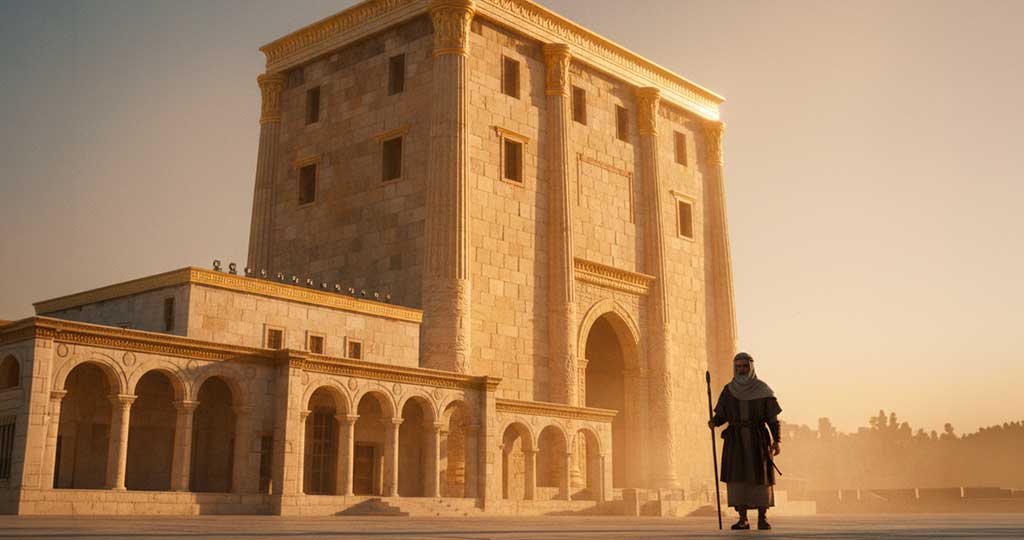
4. The 40-Year Warning: The Mystery of the Second Temple
Prophetically, the Messiah had to arrive before the destruction of the Beit HaMikdash (the Temple) in 70 AD. According to Haggai 2, the glory of the second house would be greater than the first, and Malachi 3 promises that the Lord Himself (Hashem) would visit that Temple. This was fulfilled when Yeshua performed his miracles within its courts.
Fascinatingly, the Talmud (Yoma 39b) records “strange occurrences” in the Temple during the 40 years leading up to its destruction—beginning roughly at the time of Yeshua’s death and resurrection. The Temple doors would swing open on their own, the westernmost lamp of the Menorah would not stay lit, and the scarlet thread tied to the scapegoat on Yom Kippur failed to turn white.

“The scarlet thread that was around the scapegoat that was supposed to turn white when the sins are forgiven wasn’t turning white anymore. Basically saying that God is no longer accepting your sacrifices.”
This 40-year warning confirms the prophetic countdown found in Daniel 9. The sacrificial system had shifted because the “Everlasting Atonement” had been made. The “signs” were the confirmation that the New Covenant had been inaugurated.
5. Personal Messiah vs. A Vague “Messianic Age”
In progressive modern circles, the Messiah is often reduced to a “Messianic Age”—an era of human-led social progress. However, this contradicts both the Tanakh and the “13 Principles of Faith” by Maimonides, which emphasize a personal, Davidic figure.
Traditional Jewish thought recognizes two roles for the Messiah: Mashiach ben Yosef (the suffering servant who brings atonement, as described in Isaiah 53) and Mashiach ben David (the ruling king who gathers the exiles and rebuilds the Temple). Rather than waiting for humanity to “pick itself up by its own bootstraps”—a difficult hope after the bloodiest century in history—the Tanakh promises a personal Deliverer sent to do for us what we cannot do for ourselves. Yeshua is that single figure, appearing first to suffer for sin and returning to rule in peace.
6. The Jewish Messiah: A “Divine Magnet”, A Light to the Nations

One of the most undeniable proofs of Yeshua’s (Jewish Messiah) identity is His impact on the global stage. The prophet Isaiah spoke of a servant who would be a “light to the nations” (Or L’Goyim):
“It is too light a thing that you should be my servant to raise up the tribes of Jacob… I will as well give you as a light to the nations, that my salvation may reach to the end of the earth.” (Isaiah 49:6)
Consider the paradox: Yeshua was a Jewish carpenter who never led an army or held political office and died a “scandalous” criminal’s death. Yet, He has become a “Divine Magnet.” He has led billions of Gentiles away from pagan idols to worship the God of Abraham, Isaac, and Jacob. In every corner of the earth—from India to Africa—people who have no ancestral link to Israel now study the Tanakh and pray for Jerusalem because of this one Jewish man. This global recognition is the most visible fulfillment of prophecy in human history.
7. Conclusion: The Invitation to Search for the Jewish Messiah

The narrative of Yeshua is not a “foreign” story; it is a seamless thread that runs from Genesis through the prophets to the New Covenant promised in Jeremiah 31. God’s plan has always involved a balance of perfect justice and perfect love. He requires payment for sin, but in His mercy, He provides the substitute. Following Yeshua is not an act of leaving your heritage; it is the most profoundly Jewish act a person can perform.
This is more than an intellectual exercise; it is an invitation to a heart-to-heart with your Creator. God promised a “New Covenant” for the House of Israel and Judah—one where the law is written on the heart.
Will you investigate the scriptures for yourself and ask the Creator to show you the truth, rather than relying solely on tradition or hearsay?
Bible Verse References (ESV)
Genesis 32:30 “So Jacob called the name of the place Peniel, saying, ‘For I have seen God face to face, and yet my life has been delivered.'”
Hint: Demonstrates that God manifests in physical form in the Hebrew Scriptures.
Isaiah 53:5 “But he was pierced for our transgressions; he was crushed for our iniquities; upon him was the chastisement that brought us peace, and with his wounds we are healed.”
Hint: The foundational prophecy of the suffering servant (Mashiach ben Yosef).
Daniel 9:26 “And after the sixty-two weeks, an anointed one shall be cut off and shall have nothing. And the people of the prince who is to come shall destroy the city and the sanctuary.”
Hint: Proves the Messiah had to arrive and be “cut off” before the Temple’s destruction in 70 AD.
Isaiah 49:6 “I will as well give you as a light to the nations, that my salvation may reach to the end of the earth.”
Hint: Predicts the global impact of the Messiah beyond the borders of Israel.
Jeremiah 31:31 “Behold, the days are coming, declares the Lord, when I will make a new covenant with the house of Israel and the house of Judah.”
Hint: The prophetic promise of the New Covenant (Brit Chadashah).
SOURCES: So Be It