
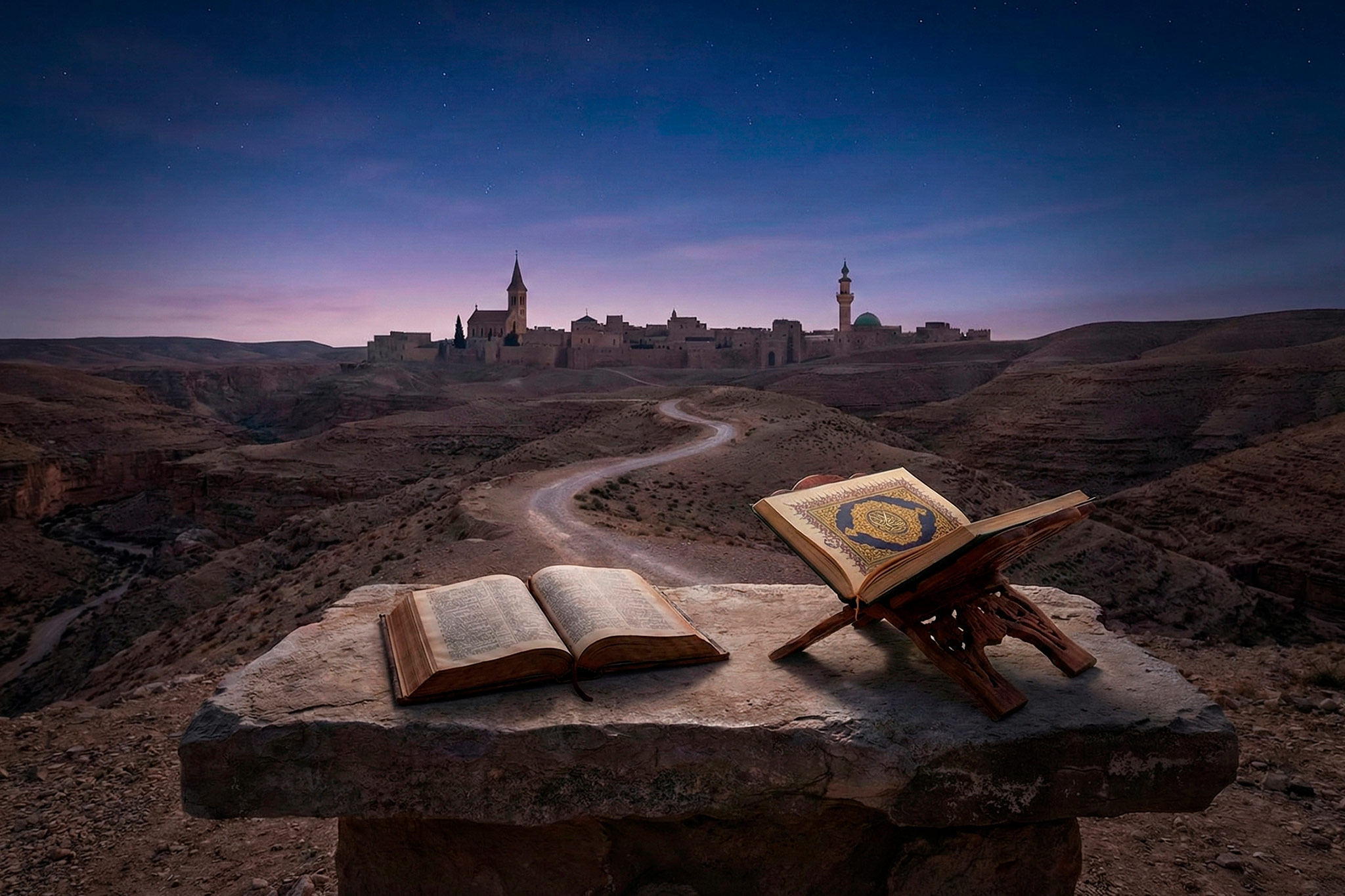
Introduction: Beyond the Sunday School Stories For many, the Bible and Quran are familiar in name only. We may know the most famous stories—Noah’s ark, Moses parting the sea, or the night journey of a prophet—but this surface-level awareness often obscures the more complex and challenging realities embedded within these texts and their histories. The common narratives we inherit are often simplified, smoothed over, and sanitized.
A deeper look into the historical records and the claims these scriptures make about themselves reveals a landscape of surprising, counter-intuitive, and profound details. This is not about confirming biases, but about engaging honestly with the sources. The journey uncovers truths that challenge common assumptions held by believers and critics alike.
What follows are five of the most impactful revelations regarding the Bible and Quran, drawn directly from Christian and Islamic source materials. This exploration promises a journey beyond the familiar stories, into the very heart of how these texts came to be, what they claim, and the difficult questions they raise.
1. The Bible and Quran: Manuscript Evidence Differences

When historians evaluate the reliability of any ancient document, they look for manuscript evidence. They ask: How many copies exist? How early are they? How much do they agree? By these standards, the New Testament is in a class of its own. According to historical analysis, it stands as the best-documented work of antiquity. To put this in perspective, most classical works like those of Plato or Aristotle survive on a few dozen manuscripts, most of which were copied nearly a thousand years after their authors died. The New Testament’s thousands of early copies place it in a completely different category of historical verification.
The reliability of the New Testament text is supported by the sheer quantity, quality, and age of surviving manuscripts. While other ancient works might survive in a handful of copies written centuries after the original, the New Testament is supported by thousands of manuscripts, some of which date remarkably close to the time of the events they describe. Through the discipline of textual criticism, scholars can group these documents into families to reconstruct the original text with a high degree of confidence. Crucially, textual analysis confirms that no significant doctrine of the Christian faith is affected by the existence of textual variants.
This vast and early manuscript trail is unique among ancient writings. It provides a foundation for textual reliability that is unparalleled in the classical world, giving historians a wealth of data to analyze when considering its claims.
2. Church Councils Didn’t ‘Invent’ the Bible—They Recognized It

A common misconception in discussions about the Bible and Quran is that a group of men, perhaps at the Council of Nicaea, sat in a room and arbitrarily decided which books would be included in the Bible. This narrative suggests that the “canon”—a word from the Greek kanon, meaning a “measuring reed” or standard—was an invention of political power. The historical record, however, tells a different story.
The principle of canonicity was not about conferring authority on books, but about recognizing the divine authority already inherent in them from the time they were written. Over centuries, the early church applied a series of corroborative tests to affirm which writings met the standard of inspired Scripture. These criteria included: being Authoritative (claiming to be from God), Prophetic (written by an apostle or someone with apostolic authority), Authentic (doctrinally sound), Dynamic (possessing life-transforming power), and having been Received and universally accepted by the church from an early stage.
This process of recognition culminated long before any single council vote. The first definitive list of the 27 New Testament books as we know them today was articulated by Athanasius of Alexandria in his festal letter of 367 A.D. Later councils, such as those at Hippo (393 A.D.) and Carthage (397 A.D.), did not create the canon; they formally affirmed the collection of books that the church had already come to recognize as the Word of God.
3. The Bible and Quran: A History of Burning Scriptures

The traditional Islamic narrative emphasizes the perfect preservation of the Quran. Yet, early Islamic sources reveal a preservation history marked by a significant crisis. In the years after Muhammad’s death, Muslims who had been taught the Quran by different companions were reciting it so differently that they began accusing each other of corruption and heresy, to the point where they “wanted to kill each other.”
To resolve this chaos, the third Caliph, Uthman, initiated a drastic standardization project. He selected one version of the Quranic text—the codex compiled by Zayd ibn Thabit—and declared it the official standard. He then gave a stunning order: all other existing Quranic materials, whether fragmentary manuscripts or whole copies, were to be gathered and burned.
This order meant the destruction of Qurans written and compiled by some of Muhammad’s most prominent companions. One of them, Abdullah ibn Masud, fiercely resisted this decree, protesting with the words: “I memorized and learned over 70 suras from Muhammad when Zed was still a little child in Medina and you want me to go to him and take the Quran from him?” His resistance was ultimately overcome, and Uthman’s chosen version became the single text for the entire Islamic empire.
This stands in stark contrast to the preservation of the Bible, where no central authority ever gathered the copies of the books written by the companions of Jesus to burn them.
4. The Bible and Quran on the Heavenly Status of Jesus

When the Bible and Quran speak of Jesus (Isa) and Muhammad after their earthly lives, they present a stark and surprising contrast in their heavenly locations and the certainty of their status. The text places Jesus in a position of immediate proximity to God, while describing Muhammad with much less clarity and certainty.
According to the Quran, Jesus’s status is one of direct elevation. Surah 3:55 records Allah saying, “Oh Jesus I will take you and raise you up to myself.” This verse explicitly places Jesus with Allah. In Islamic theology, since Allah is above the seven heavens on His throne, this means Jesus was taken to be directly with God in the highest place.
Muhammad’s status after death, according to Islamic tradition, is different. He is said to be in his grave, in a state known as Barzakh—a “heavenly grave,” but a grave nonetheless. This contrast is sharpened by framing it in terms of certainty versus uncertainty and proximity versus distance. The Quran describes Jesus’s post-earthly state with absolute certainty and direct proximity to God. Conversely, it describes Muhammad’s with ambiguity and relative distance. In Surah 46:9, Muhammad himself is instructed to say, “I do not know what shall be done with me or with you,” underscoring an uncertainty about his own final outcome that stands in direct opposition to the Quran’s description of Jesus.
5. The Quran’s Test for a False Prophet Eerily Matches Muhammad’s Death

The final surprising truth involves a specific test found in Islamic scripture. The Quran sets its own clear and severe standard for judging a false prophet. It warns that if a messenger were to fabricate sayings and attribute them to Allah, the punishment from God would be swift, specific, and fatal. This internal test becomes deeply challenging when compared with the details of Muhammad’s death as recorded in Islam’s most trusted traditions.
First, the warning. Quran 69:44-47 states that if the messenger had fabricated any sayings in Allah’s name, Allah would have seized him by the right hand and then “severed his aorta.” The text is explicit: the punishment for fabricating revelation is having one’s life artery cut.

Next, the death. According to Sahih al-Bukhari, one of the most authoritative collections of hadith, Muhammad died from the lingering effects of being poisoned by a Jewish woman years earlier. As he lay dying, he described the feeling of the poison working within him to his wife, Aisha. In a tradition recorded in Sahih al-Bukhari, Volume 5, Book 59, Hadith 713, he is recorded as saying: “I still feel the pain caused by the food I ate… and at this time I feel as if my aorta is being cut from that poison.”
Muhammad’s own description of his death uncannily mirrors the exact punishment the Quran specifies for a messenger who fabricates revelation in God’s name.
Conclusion: The Texts Demand a Closer Look The foundational texts of Christianity and Islam are far more complex and contain more challenging details than is commonly believed. From the overwhelming manuscript evidence for the New Testament to the burning of early Qurans, and from the exalted position of Jesus to the haunting details of Muhammad’s death, the sources themselves present a picture that defies simple narratives.
This is not about declaring a “winner” or a “loser” in a theological debate. It is about acknowledging the weight of the evidence as it stands. When the historical records of the Bible and Quran present such profound and challenging questions, what does it compel us to do with our easy assumptions?
SOURCE: Muslim CRITICIZES The BIBLE But ABSOLUTELY REGRETS It | Sam Shamoun


