
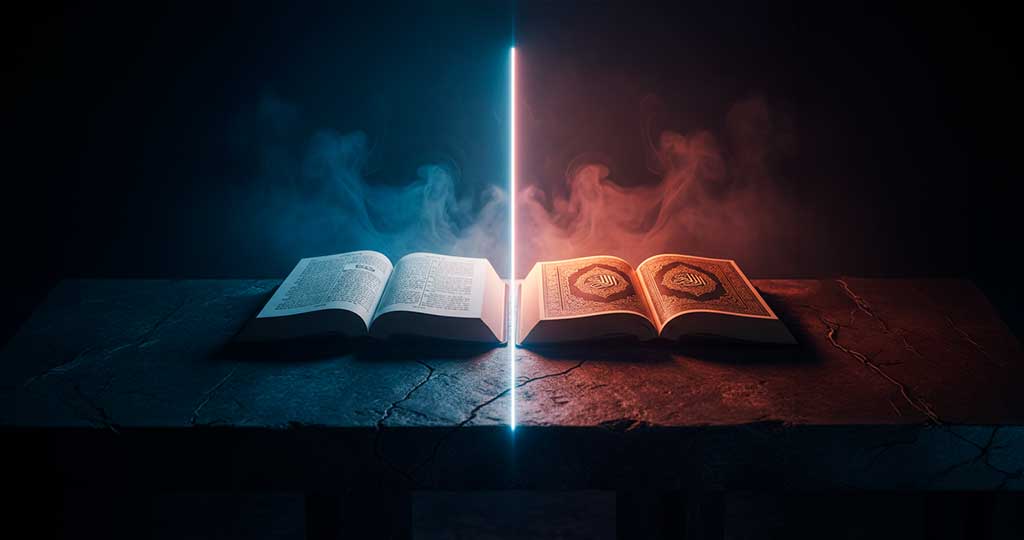
Religion is frequently a matter of inheritance rather than investigation. For many, faith consists of a collection of traditions passed down through generations, seldom subjected to the rigors of historical or textual scrutiny. However, when the primary sources of Islam and Christianity are placed in direct dialogue, a series of logical and theological crossroads emerge. This tension is often referred to as the Islamic Dilemma—a specific logical trap where the Quran’s own verses appear to undermine its authority by validating the very scriptures that contradict its core message.
The following takeaways distill high-impact theological debates, highlighting the inconsistencies that arise when believers move beyond modern commentaries and engage directly with the claims of their own texts.
1. The Uncreated Nature of Jesus (The “Word” Paradox)

A central pivot point in this interfaith dialogue is the ontological status of Jesus. While standard Islamic teaching classifies Jesus as a mere human prophet, the Quranic text identifies him as both the “Word of Allah” (Kalimat Allah) and a “Spirit from Him” (Ruhun Minhu). This creates a profound theological parallel to the Islamic view of the Quran.
In Islamic orthodoxy, the Quran is considered the “uncreated” word of Allah, existing eternally as an expression of His nature. If Jesus is explicitly titled the “Word of Allah,” the logical bridge is unavoidable: a word cannot be separated from the one who speaks it.
“The word of Allah cannot be separated from Allah… even though there’s a distinction… there’s an identical nature that they share. That divine nature they’re united in. The word is united with Allah. It’s not separate from Allah.”
2. The “Gospel of Barnabas” and the Forgery Trap

In the quest to find Muhammad mentioned in the Bible, many modern seekers rely on footnotes in popular digital tools. However, historical analysis reveals this to be a significant “forgery trap.” While Muhammad lived in the 7th century, the Gospel of Barnabas was authored between the 13th and 15th centuries. This 600-to-800-year gap renders it historically useless for validating a 7th-century claim. More importantly, the text contains a massive internal contradiction: it explicitly labels Muhammad as the “Messiah,” directly contradicting the Quran’s own identification of Jesus as the Messiah.
3. The Islamic Dilemma: A Logical Self-Refutation
The most rigorous challenge to the internal consistency of the Quran involves a “trilemma” found in Surah 5:47, 10:94, and 16:43. In these verses, the Quran commands Christians to “judge by the Gospel” and instructs Muslims who are in doubt to “ask the people of the reminder.” This creates an inescapable logical self-refutation regarding the Islamic Dilemma:
- If the Gospel is true and preserved: The Quran is false because the Gospel contains doctrines—such as the divinity, death, and resurrection of Jesus—that the Quran explicitly denies.
- If the Gospel is corrupted and false: The Quran is still false because it affirms the authority of the Gospel as a standard of judgment and a source of verification for its own message.
4. The Moral Boundary: Surah 65:4 and Objective Ethics

Ethical debates often center on the concept of “Objective Morality”—the idea that certain actions are inherently wrong regardless of culture or consensus. A primary friction point is Surah 65:4, which outlines waiting periods for divorce. The text includes specific provisions for “those who have not yet menstruated.”
“There are objective morals. This is one of them. It is never okay to have any relations with a child. Never. I don’t care what generation you’re in… that still doesn’t make it okay. It’s wrong.”
For the analytical seeker, this presents a moral boundary. If a text provides a permanent legal framework for actions that violate objective ethics, it challenges the claim that the text is the product of an all-good, divine source.
Conclusion: A Final Thought for the Seeker

The path to truth requires the courage to verify scriptural claims through primary historical documents. When a text claims to confirm previous scriptures while simultaneously contradicting their core message, it reinforces the gravity of the Islamic Dilemma. Can a text be considered divine if it requires its followers to ignore the very scriptures it claims to validate?
Bible Verse References (ESV)
John 1:1 “In the beginning was the Word, and the Word was with God, and the Word was God.”
Hint: Confirms the uncreated, divine nature of Jesus as the eternal Logos.
Galatians 1:8 “But even if we or an angel from heaven should preach to you a gospel contrary to the one we preached to you, let him be accursed.”
Hint: Warning against “new” revelations that contradict the preserved Gospel.
Numbers 23:19 “God is not man, that he should lie, or a son of man, that he should change his mind.”
Hint: Supports the argument that divine truth and morality do not shift with cultural trends.
1 John 5:20 “And we know that the Son of God has come and has given us understanding, so that we may know him who is true; and we are in his true Son Jesus Christ. He is the true God and eternal life.”
Hint: Directly addresses the Christian claim of Jesus’ divinity which the “Dilemma” highlights.
SOURCES:
- Young Dawah Kid Learns He Has Been Lied to, GodLogic 2.0
- Muhammad Lied And His Morals Were Off, GodLogic 2.0

